News2nd Feb 2026
Strong year-end finish as we crown the "Reklamebørsen" winners for 2025

Article's author
Share article
In a turbulent world, we seek traditions and some stable anchors. Now that the Christmas peace is definitively behind us and the world has never been more unpredictable, it is therefore appropriate to uphold one of the year's regular and hopefully long-awaited, professional traditions; a summary of the Advertising Film Year with Reklamebørsen as a rearview mirror.
Reklamebørsen 2025
Throughout 12 monthly rounds in 2025, we evaluated a total of 123 films across 90 different brands. Common to the films we measure in Reklamebørsen is that they must have run with significant reach/frequency, and that they should be what we often refer to as brand-building advertising, i.e., not tactical price/product advertisements. In Reklamebørsen, we focus on advertising's ability to deliver positive (liking) ad recall (attention), in a cost-effective manner (relative to reach/frequency), and whether it is perceived as easy to associate the correct sender with the advertisement (branding).
Overall Development
Ad recall for advertising films has remained stable at around 40 percent in recent years. 2025 was no exception in this regard, despite both declining linear TV viewership and occasional conflicts between TV companies and distributors. Also, regarding the distribution across platforms, it is virtually unchanged from previous years, with TV remaining the clearly most important attention driver.


However, if we delve a bit deeper into the numbers, we observe some clear trends. Excluding those over 50 years old, we have seen a somewhat negative trend in ad film attention in recent years. Among those aged 30 to 39 (the most demanding segment), average attention fell by a full 3 percentage points from 2024 to 2025, driven by a corresponding decrease in the proportion recalling ads from linear TV.

The declining proportion of people who believe they have seen ads on TV, especially among younger viewers, is no surprise given the sharp decrease in linear TV viewing in this group. Perhaps more surprising is that across all age groups, TV is still attributed the largest share of ad recall (22% from TV and 14% from OLV among the youngest in 2025, respectively). The explanation likely lies partly in the fact that the TV screen is used for much more than linear TV viewing, and when the Norwegian public states they recall ads from TV, they do not distinguish between linear TV and other uses of the large screen. Both BVOD (Broadcaster Video-On-Demand) and other streaming services thus contribute to the TV screen continuing to be the most important platform for advertising (films) going forward.
So, ad films were indeed still noticed and remembered in 2025. But do ad films still manage to engage Norwegian consumers in a positive way? If we compare with the early years of Reklamebørsen (2006-2009), the answer is likely no. During this period, 15-20 percent of the ad films we measured scored over 40 percent positive liking, compared to 5-10 percent in recent years. On average, films in recent years also score lower than in Reklamebørsen's early days, but if we disregard the very first years, the negative trend is far less pronounced.

The preliminary low point for ad film liking was reached in 2022 when the average proportion of positive liking was 22 percent, and only 3.6 percent of the measured films scored over 40 percent positive liking. Since then, we have actually seen a certain positive trend, with a particularly clear boost in 2025 where a full 8.1 percent of films scored over 40 percent positive liking. So, although there's still a way to go to reach the truly strong years, the Advertising Year 2025 indicates that we are at least on the right track.

The Films We Remembered
Since 2015, only telecom companies and grocery chains have been full-year winners for attention in Reklamebørsen. 2025 was no exception – with Telia's film "Little Brother," where the older sister had been so engrossed in screens that she hadn't noticed she had a little brother, being the film most people remembered seeing.
Directly behind Telia followed the grocery chains Extra, Obs, and then Extra again, and even though Telia claimed victory, it's difficult to overlook Extra and Obs when discussing attention winners in 2025. Extra had a total of 3 films in Reklamebørsen in 2025, all 3 of which ended up in the Top 10 for recall. Something similar applies to Obs, which had both of its two films, both featuring Bosse, placing 3rd and 7th respectively. In comparison, Rema 1000 was measured 4 times, Meny 3 times, Prix 2 times, and Kiwi 2 times, yet none of these reached the Top 15.
An advertiser who unusually did not make it this year was Telenor. Telenor has garnered no less than 6 attention victories in the preceding 10 years, but none of its 3 measured films made it into the Top 15 in 2025.
Although there are many elements crucial for being remembered, it is obvious that media pressure is one of the most important. Extra's grocery dominance is an example of attention that is at least partly driven by high pressure, with an average of 770 TRP30 for its measured films (even though this is not significantly higher than, for example, Rema's average of 600 TRP30 for its four films). Obs and Bosse's success can also be partly explained by high TV pressure, where the launch film actually ran with the highest TRP30 of all last year's films in Reklamebørsen.
High pressure, however, is not a guarantee, and among the 15 films with the highest pressure, only 4 made it into the Top 15 for attention. And it's worth noting that both Telia's "Little Brother," OMO's "Stain Removal," and both TINE's films on the top list ran with under 500 TRP30. Common to these was that they all engaged positively and were among the year's most liked films, with three of them making it into the Top 15.

The Films We Liked
2025 long seemed set to be a historically weak year for 'liking'. After the first 8 months of the year, only 2 films had scored over 40 percent on liking, but an exceptionally strong autumn boosted this number into double digits for the first time since 2021. That the strongest films appear in the autumn is not a new phenomenon in itself. The last 4 months of the year are, on average, the strongest 'liking' months, but this year the final sprint was particularly strong, and especially in November and December, films scored well above the average for these historically strongest months.

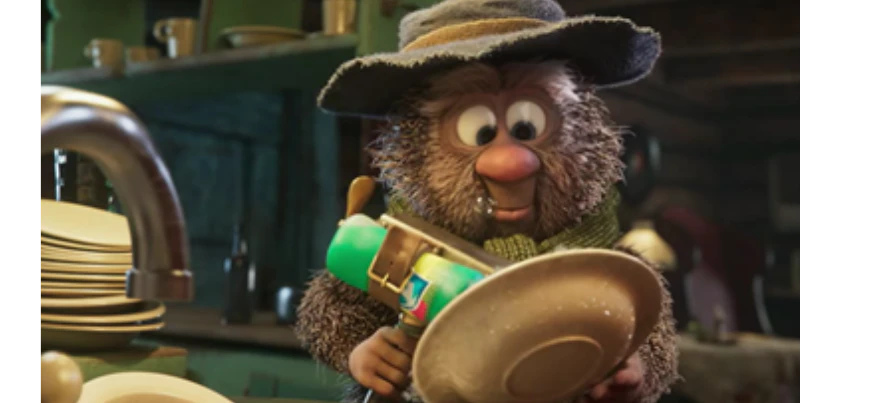
This year's most-liked film was delivered by Zalo and Try. Similar to the liking winner for 2023, Möllers Tran, this year's liking winner draws inspiration from the Flåklypa universe, and it actually works just as well this time. A full 58 percent liked this film more than other commercials, making 2025 the third consecutive year an animated film won as the year's liking champion (Vy/Pol and Revefamilien (The Fox Family) won in 2024).

Behind the clear winner, the competition was tight among the next films on the top list. Hennig-Olsen Is secured second place a few decimal points ahead of Infinitum, while Tine's Fjøsnissen-comeback and Felleskjøpet's film about FK being for everyone took the subsequent spots. Obs and Bosse, by the way, were the only ones to reach the Top 15 with more than one film.
As before, there was a predominance of longer formats among the most-liked films. A full 8 out of the Top 15 films were in 45-second format or longer. The winner, Zalo, however, ran only in a 20-second format, just like Möllers Tran in 2023. Humor has also often been part of the recipe for liking winners. 2024 was an exception to this rule, as only seven of the 15 most-liked films used humor, and none of the top three most-liked films employed humor as a creative device.
In 2025, it appears that advertising agencies generally hit the mark better with humor. In fact, 9 out of the 10 most-liked films, and a full 12 among the Top 15, used humor in some form as a creative device. This means that the top list was actually even more humor-driven than in the years before 2024, and not since the Covid year 2020, when humor in advertising provided a welcome break from all the seriousness, have films with humor delivered so much higher liking than films without humor.

Clearest Branding
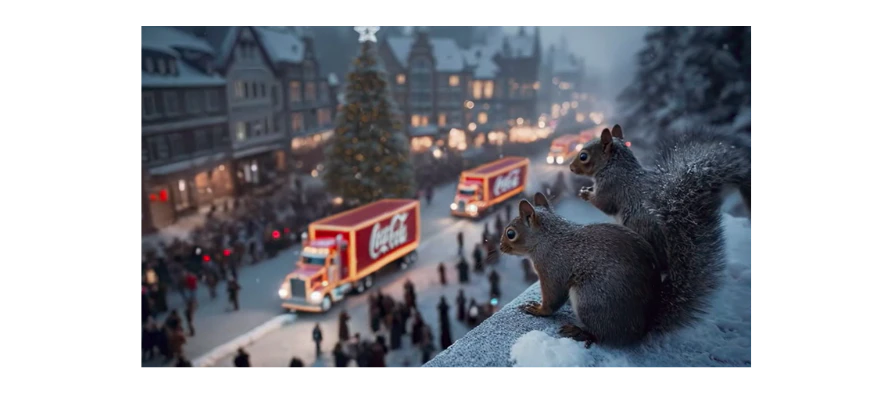
Nothing is more Coca-Cola (or more Christmas spirit) than a Christmas-decorated trailer, and consequently, no one could compete with Coca-Cola's Christmas film for the title of "clearest branded commercial" in 2025.
Among the films with the strongest branding, a full 8 films come from established creative universes, while an additional 5 films are made with an established "style and tone" from the advertiser. Among the Top 15, we thus find only two "completely independent" films: Flytoget's "pack mule" and Felleskjøpet's "FK is for everyone." These therefore perhaps deserve extra kudos for the way they clearly and well integrated their brands into the stories (PS. FK's film has since become the start of what is now an established creative concept).

The Year's Best Commercial
To select the year's best commercial, we combine the three key parameters – Attention (recall), Liking, and Branding – into an overall score for "Positive Brand Attention." The score then represents the proportion who BOTH recall the advertisement AND liked it more than other advertisements AND found it easy to connect it to the sender.
With the caveat that we do not measure everything that is important in Reklamebørsen (among other things, we do not measure message comprehension), we choose to declare the film with the highest Positive Brand Attention as "The Year's Best Commercial."
The winner of this year's best commercial is Obs’ Bosse Jul.
Obs' new main character Bosse was launched as late as November, and while the launch film ultimately ended up in 5th place for positive brand attention, the sequel "Bosse Jul" climbed all the way to the top in Reklamebørsen 2025. The film was among the year's 10 strongest in terms of attention, liking, and branding, an achievement also reached by this year's second-place Omo with its film where Kjell is worried about a mole that turns out to be brown sauce. Also in third place, we find an established character with TINE's very own Fjøsnissen (Barn Elf) who was "re-launched" this year after some years away from the screen.
It is also worth noting that Coca-Cola's latest AI version of "Holidays are coming" lands firmly in 4th place overall when we summarize the advertising year 2025.

What have we learned?
In an unpredictable world, it's good to have some stable points of reference to navigate by. As we enter a new year, I therefore want to remind everyone that even though people's media habits are changing, many of the principles we, as marketers, must work by remain the same. Among other things, mental availability is at least as important in an increasingly digital world, with advertising film as the most crucial building block. It is precisely the ability of advertising films to build this mental availability that we, in a somewhat simplified way, try to measure in Reklamebørsen.
So, what did we learn from Reklamebørsen in 2025? This year's most successful brands didn't just buy reach; they created resonance. They succeeded by:
Embracing Entertainment: They understood that humor and storytelling are not unnecessary embellishments, but powerful tools to cut through the noise and build positive associations.
Building Recognition: They invested in consistent creative platforms and memorable characters (like Obs' Bosse, OMO's Kjell & Tore, TINE's Fjøsnissen, and Coca-Cola's Christmas trailer) that build brand value over time.
Integrating the Brand: They made the brand an indispensable part of the story, thereby ensuring that positive feelings were directly linked to the sender.
None of this is new or unknown to those of us working in marketing, but even elementary messages require frequency to ensure mental availability in an increasingly fragmented media landscape where every advertisement is expected to deliver on a thousand more or less important KPIs. The recipe for success in 2026 is clear. Reach is a commodity; resonance is the competitive advantage. To succeed, we must not only reach out, but also be remembered and liked. And to achieve that, brands must dare to create advertising that the audience actually wants to see.
Autumn 2025 was a bright spot in that regard.
Happy New Year!